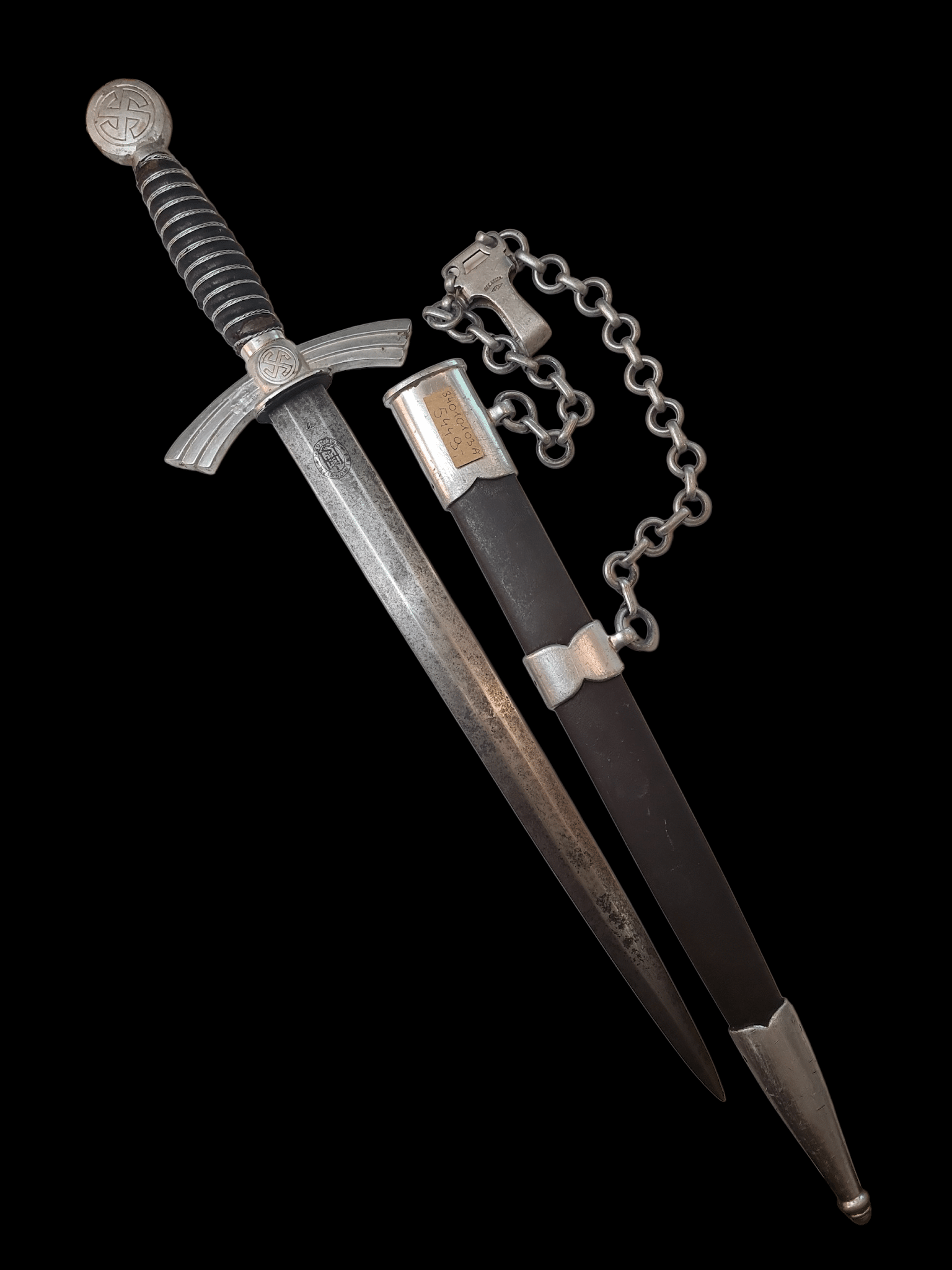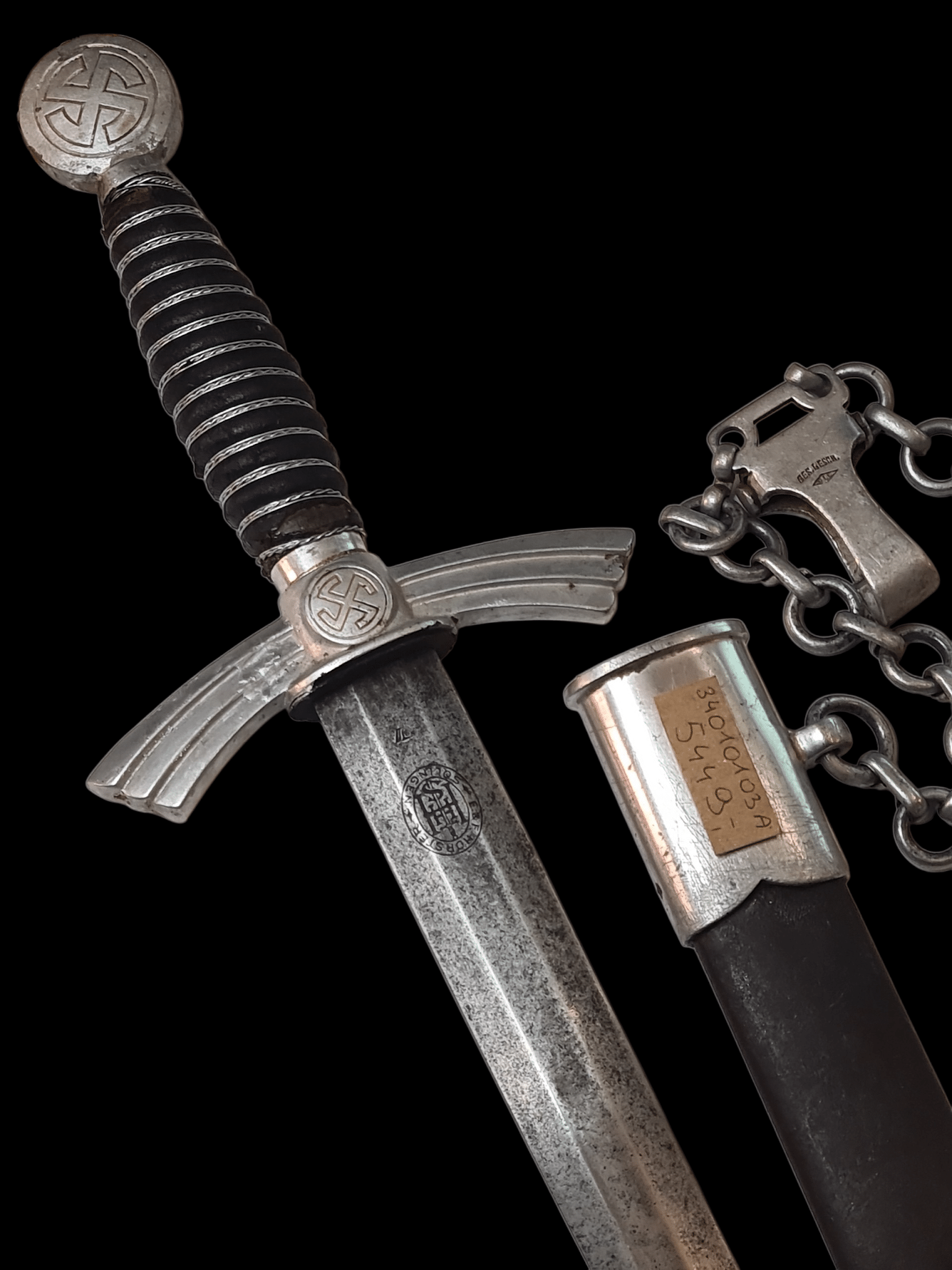
Luftwaffe officer's air force dagger of the Third Reich 1939 -44
Here is detailed information about the Luftwaffe air force dagger model pattern 1934/35 (First Pattern Luftwaffe Dagger):
History and origin
This model directly derives from the dagger introduced in 1934 for Deutscher Luftsportverband (DLV) – the German Air Sports Association. The DLV was a civilian organization which, under the guise of air sports, trained personnel for the future air force, thus circumventing the restrictions of the Treaty of Versailles prohibiting Germany from having a military air force.
After the official creation of the Luftwaffe in March 1935, a modified version of the DLV dagger was adopted as the official dagger for Luftwaffe officers and non-commissioned officers holding a valid pilot's license. This is where the designation "pattern 1934/35" comes from.
Symbolism and meaning
This dagger symbolized the modernity and technological character of the Luftwaffe. The use of aluminum in the fittings was not accidental – in the 1930s, aluminum was an innovative material, associated with the aviation industry. The gilded sunwheel swastikas on the grip and crossguard emphasized the connection of the Luftwaffe with the Nazi state and gave the weapon a ceremonial character.
Production period
The first pattern was produced from 1934/35 until July 15, 1937, when the second pattern was introduced. Despite the introduction of the new model, already issued examples remained in use, and production of the first pattern was discontinued.
Characteristic features
Blade
-
Steel, double-edged, stiletto style
-
Length approx. 30-31 cm (total approx. 42-45 cm)
-
Often decorated with etched aviation motifs (eagles, swastikas)
-
Marked by renowned manufacturers from Solingen (e.g. E. Pack & Sohn, Alcosa, Anton Wingen Jr.)
Grip
-
Wooden core wrapped in blue Moroccan leather (so-called blue Moroccan leather)
-
Wire wrap (often silvered) – usually arrangement: two twisted wires surrounded by single straight ones
-
Characteristic blue color of the grip (Luftwaffe color)
Pommel and crossguard
-
Crossguard: in the form of downward-sloping, stylized wings
-
Pommel: round, decorated with a gilded sunwheel swastika on both sides
-
Early examples (until 1936) had fittings made of nickel silver, later ones of polished aluminum
Scabbard
-
Covered with blue Moroccan leather (often with a "pebble-grain" texture)
-
Three fittings: throat, middle fitting, and chape
-
Fittings attached with flat screws
Chain
-
Two-part suspension chain (for fastening under the uniform)
-
Early versions: 7 links in the upper and 9 in the lower chain (for nickel fittings)
-
Later versions: even 9 and 14 links
-
Ending with a clip for attaching to the belt
Use
The dagger was worn exclusively for ceremonial purposes – with the dress uniform and during ceremonies, never at the front. It served a ceremonial function and was an expression of belonging to the elite officer corps of the Luftwaffe. It was also referred to as a "Borddolch" (deck dagger), because it was originally intended for officers serving in aviation – literally "on board" aircraft.
End of use
Wearing the Luftwaffe dagger was prohibited by order of December 23, 1944.
Product Information
Product Information
Shipping & Returns
Shipping & Returns