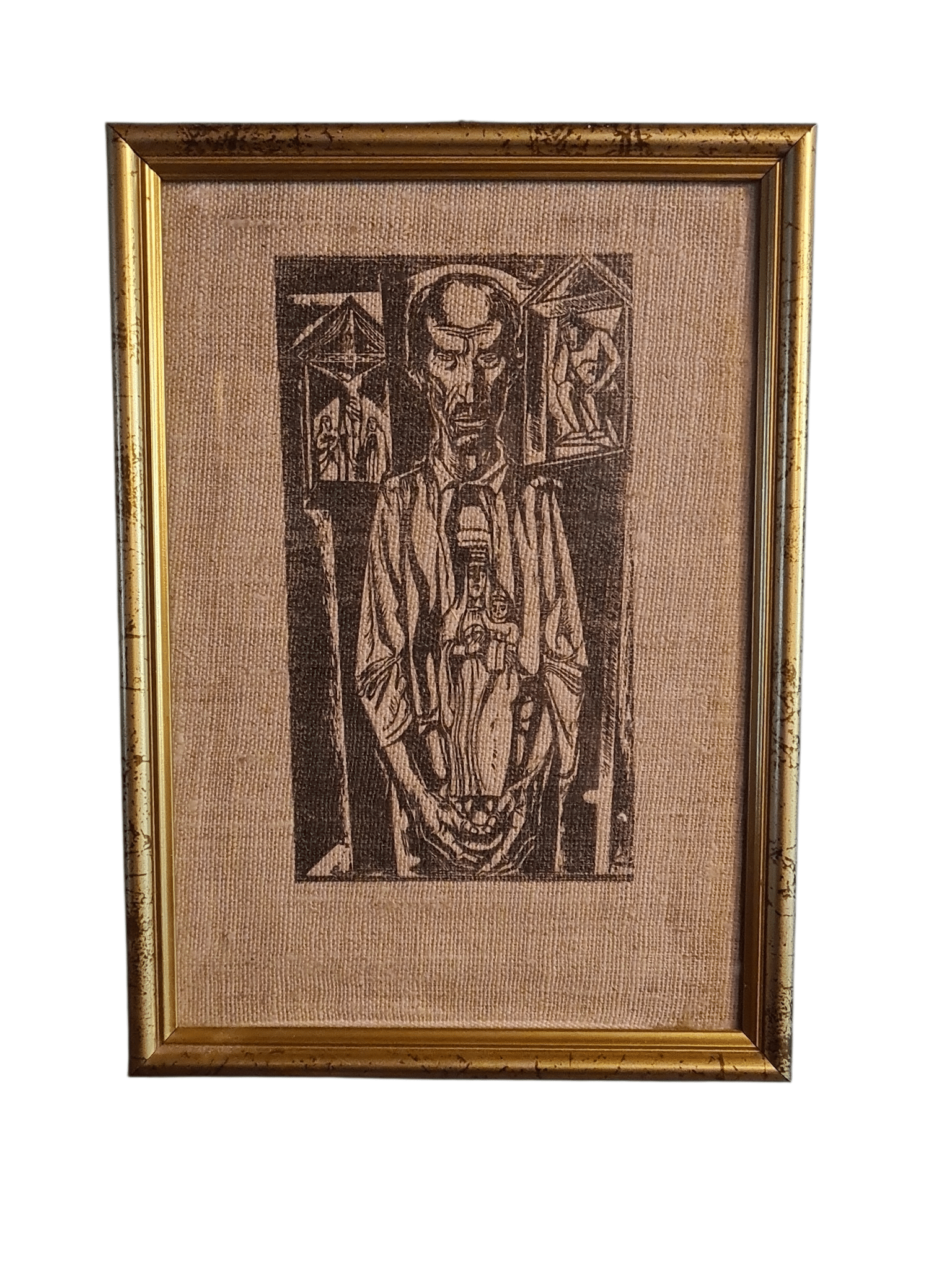

Kulisiewicz – small linocut on fabric, 20th-century artistic graphic
The work probably comes from the post-war period, when Kulisiewicz created his most recognizable graphic cycles. Although the format is intimate, the power of expression and precision of execution make it a true collector's gem. It is not only a decoration, but above all a testament to the skill of one of the most important Polish graphic artists of the 20th century. An ideal proposition for art lovers, graphic collectors, and seekers of original, small works of art with great artistic value.
- Artist: Kulisiewicz (Polish graphic artist, draftsman, representative of modern woodcut and linocut)
- Technique: Linocut on fabric
- Dimensions: Small format – ideal for framing with a passe-partout and small frame
- Condition: Good, consistent with age – signs of time add authenticity
- Origin: Poland, 20th century
Tadeusz Kulisiewicz (1899–1988) – master of line and graphic art
Tadeusz Kulisiewicz was born on November 13, 1899 in Kalisz, and died on August 18, 1988 in Warsaw. He was one of the leading Polish graphic artists and draftsmen of the 20th century, commonly referred to as the "master of line".
Life and artistic path:
Education: He studied at the State School of Decorative Arts in Poznań (1922-1923), and then at the Warsaw School of Fine Arts (1923-1929) under the guidance of professors, including Władysław Skoczylas and Miłosz and Mieczysław Kotarbiński.
Academic career: From 1946 he was a professor of drawing, and later of graphic art at the Academy of Fine Arts in Warsaw.
Membership: He belonged to the prestigious Association of Polish Graphic Artists "Ryt", and also became a corresponding member of the Akademie der Künste in Berlin (1955) and an honorary member of the Accademia di Belle Arti in Florence (1965).
Commemoration: He rests at the Powązki Military Cemetery in Warsaw. Streets in Kalisz and Szlembark have been named after him, and in Kalisz the Center of Drawing and Graphic Art bearing his name operates.
Work and awards:
Style and themes: The artist was fascinated by the life of ordinary people, which is visible in his famous cycles of woodcuts depicting the inhabitants of the Podhale village of Szlembark. His style, initially close to expressionism, was characterized by strong contrasts and a tendency to simplify form.
Awards: His talent was recognized internationally. He received, among others, the UNESCO Prize at the Venice Biennale (1955), the first prize at the São Paulo Art Biennial (1961), and the Gold Medal at the International Biennale of Graphic Art in Florence (1970). He was also a laureate of the State Award of the first degree.
Product Information
Product Information
Shipping & Returns
Shipping & Returns