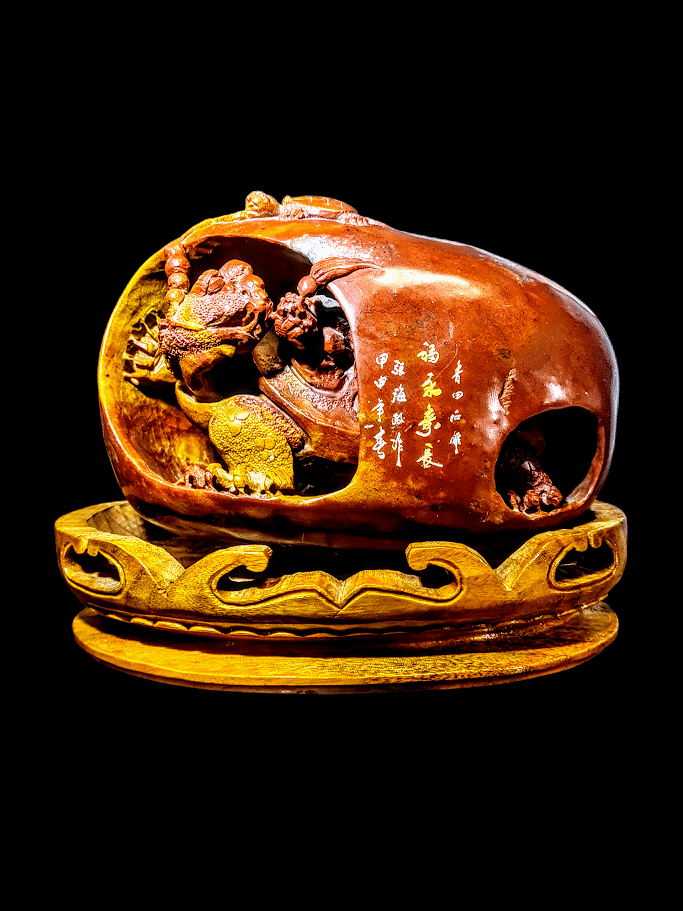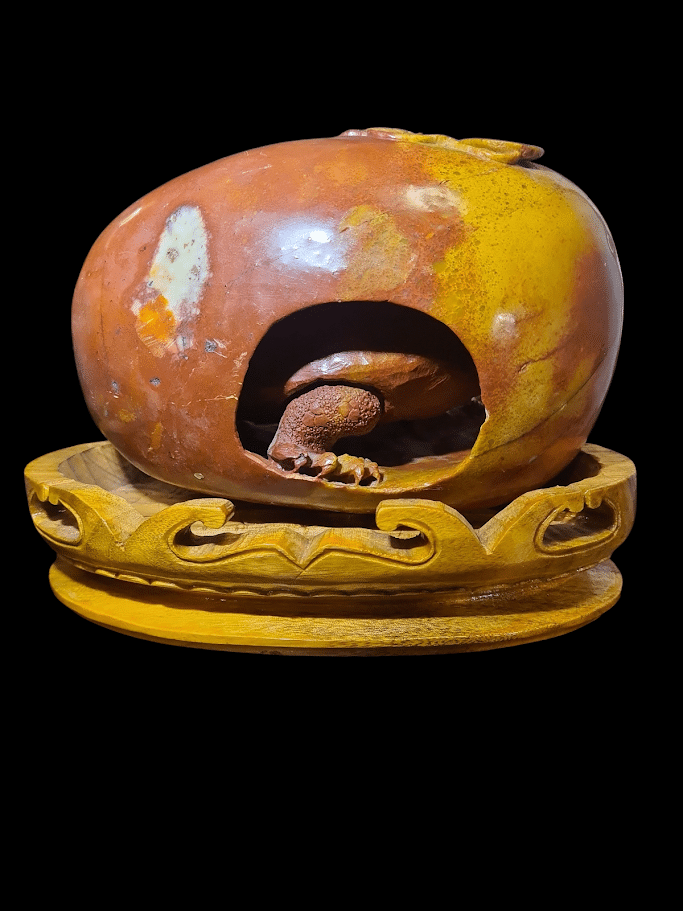
Impressive stone sculpture on a wooden base - turtle in egg, China, early 20th century.
Soapstone (steatite) is a metamorphic rock composed mainly of talc, often with admixtures of chlorite, mica, amphiboles, and carbonates. Its name comes from the "soapy," greasy feel of its surface.
2. Key properties:
-
Softness and ease of carving: It is exceptionally soft (approx. 1-2.5 on the Mohs scale), making it an ideal material for hand carving with chisels. When first mined it is relatively hard, but becomes more brittle after drying.
-
Warm to the touch and "greasy" texture: A characteristic feeling of smoothness and warmth, distinguishing it from the cool feel of marble or jade.
-
Heat resistance: It has excellent insulating properties, which is why it was historically used for making cooking vessels, stoves, or pots.
-
Color range: It occurs in a wide range of colors: from silvery-gray and greenish through yellows, beiges, to deep browns and red. It is often veined.
3. Significance in China and art: In China, steatite (known there among others as huāgāngshí) has been used for centuries, especially for producing small, intricate carvings, seals, desk accessories (like brush rests), and ornaments. It was valued for its workability and ability to take a polish. Soapstone carvings are characteristic of folk art and artistic craftsmanship, especially from regions rich in deposits (e.g., Fujian, Zhejiang provinces).
Symbolism of the Turtle in Chinese Culture
The turtle (guī) is one of the most important and most positive symbols in Chinese tradition.
1. Longevity and Immortality: The turtle lives a very long time, so it is a living embodiment of the dream of a long life, health, and vitality. It is often an attribute of immortals (Xian) and the god of longevity, Shou Xing.
2. Wisdom and Knowledge: Its slow, deliberate movements are associated with wisdom, patience, and life experience. It was believed that the turtle carries the secrets of the cosmos on its shell.
3. Stability and Protection: The hard shell symbolizes impenetrable defense, durability, stability, and safety. The turtle is a "guardian" of homes.
4. Cosmos and Mythology: In Chinese mythology, the world is supported by four elephants standing on the shell of a giant turtle Ao. Its underside (plastron) represented the Earth, and its domed top (carapace) represented Heaven.
5. Element of Water and North: In the system of five elements, the turtle (specifically the Black Turtle – Xuánwǔ) is the guardian of the North, a symbol of winter and the water element. It also represents regenerative power.
6. Symbolic connection with the Phoenix, Dragon, and Unicorn: The turtle (along with the dragon, phoenix, and unicorn qilin) is one of the Four Spiritual Creatures, the king of shelled/armored creatures.
Meaning of the "Turtle in Egg" Motif
This motif is exceptionally interesting and deepens the symbolism:
-
Double symbolism of beginning and longevity: The egg is a universal symbol of the beginning of life, potential, rebirth, and hidden treasure. Combining it with the turtle creates a metaphor of "a beginning that carries within it the seed of immortality and wisdom".
-
Hidden value and surprise: The sculpture literally hides its most precious message (the turtle) inside an egg form. This can symbolize hidden wisdom, potential that needs to be discovered, or a secret.
-
Artistic uniqueness: It is a rarer and more refined motif than a standalone turtle figurine, testifying to the artisan's ingenuity.
Summary for the item description:
This object is not just a decoration – it is a material embodiment of rich symbolism. It depicts a turtle – the guardian of long life and wisdom, emerging from an egg – a symbol of pure potential. It is made from soapstone – a material valued by Chinese artisans for its workability and the warmth it brings to an interior. The whole constitutes a unique item of decorative art, carrying a deep, positive message.
Product Information
Product Information
Shipping & Returns
Shipping & Returns